Showing posts with label cost of investment. Show all posts

Thursday, August 25, 2011

PEOPLE IS STILL WAITING TO BUY EVEN THE GOLD PRICE IS LOW. WHY??

I am writing about people's strange behaviour towards investment.


What do you see above? Gold price falls. This is great isn't it? What does it mean? It means that you can buy some more to add to your investment. Buy low sell high. For gold business owners, they will start to stock up their gold stock.

Why is individuals not buying? There are many reasons among them:
  1. they does not know where to buy
  2. they does not know the return of gold investment
  3. they are afraid being cheated
  4. they are skeptical whether they can sell off the gold bar easily
  5. they are low risk takers, they prefer keeping their money at the banks
  6. they do not have money to buy
  7. they do not know where to keep their money
  8. they need guidance
  9. they cannot decide
  10. they are overloaded with information
Do you have these questions linger in your mind? Have you address them? Have you found the answer? It is actually worth to find the answer as the return of investment for gold is high compared to other avenues. Take Action, don't talk only.

This evening price is lower compared to this morning.


The price is updated ever 20 minutes. So, if you see a good price, good if you grab them now. In commodities like gold, there is no written rule eg price should go up due to this this & this, price should come down due to this this and this. We are just a small player in the playing field, just follow the flow. The price comes down, you buy. When it goes up you sell.

Do you know that Public Gold can offer you to sell online? That is indeed a very good solution to investors. 24-hours flexibilities is what we all need to take control of our money.

Enough talking... Now the action time!


Monday, June 20, 2011

INFLATION, STAGFLATION, DEFLATION: GOLD AND SILVER STILL GREAT INVESTMENTS

Why gold (and to a perhaps lesser extent silver) is the asset of choice to hold in uncertain economic times when any one - or all - of inflation, stagflation or deflation may become prevalent

Author: Julian Phillips (Reuters)

BENONI -

In this article we look at some critical fundamental features of precious metals that are rarely considered or accepted in the developed world markets. Expert investors like Warren Buffet look at inactive, buried gold with amazement, because he is focused on companies that produce things and earn money. And most of us wish we had his skill and money behind us.

George Soros and the like invested in gold as an anti-deflationary measure. Most analysts appreciate the anti-inflationary value of gold and silver. The protection of gold and silver in stagflationary environments are a combination of both abilities.

But why are gold and silver capable of giving such protection in bad times as well as good times?

They have certain qualities that shine forward at times when other investments fail.

THE LIMITATIONS OF CASH

In times of monetary stability and soundness, safely-stored cash never fails. Most consider cash in the bank to be the safest conservative investment, and in the distant past, the days of our grandfathers, this was largely true.

But that horrible word, inflation, came into being where prices kept on rising and cash saved would buy less-and-less. Interest rates compensated for this inflation, but then interest rates stopped rising. When interest rates did rise, it was at a slower pace than inflation. Cash lost its buying power as time went by. Bank charges would eat away any gains that might be made. At first inflation would occur one country at a time, and the exchange rate on those currencies fell, hurting international buying power even more. Today inflation is a global phenomenon.

Investors would have to move out of cash and into businesses or other investments that offset the cost of inflation. This was not easy unless inflation happened while growth was vibrant. And this benefitted those middle classes that enjoyed such growth. The poor, whose income rises slower than inflation, feel the pinch.

Suddenly, booms turn into busts and businesses don't do well. The value of businesses and its shares fall, losing investors money. Even self-managed businesses fall in value, putting rich people into bankruptcy. This is deflation, a monetary mood that causes values to shrink. In deflation the value of cash grows as prices fall.

Those who believe they are skilled investors answer, sell, then cheaply buy back. We look at that timeless story of an investor who did that just before the Wall Street Crash. His friend did not do so well selling only when the fall was half way down. But our hero who sold at the top, overwhelmed by his own skill bought back in, when the fall was half way down. His friend did not buy back in, but stayed in cash. It's not so easy!

Then you get a situation when the bust happened and all of the markets plummet because forced selling drives investors out. Interest rates fall to negative levels. If cycles are consistent, there should have followed a boom period. But growth was so anemic that stagnation set in. Businesses and the economy struggle to find small amounts of growth and some cut back, turning over at survival level.

Suddenly, something that shouldn't happen in a downturn happened. It was inflation, driven by factors no government can control. It came from energy and food and became uncontrollable. This type of inflation is deflationary. Businesses covering expenses suddenly found their costs ate away at profits much the same as deflation and inflation would have done. This is ‘stagflation', a climate where stress levels steadily eat away at sanity.

Surely bills and bonds are a way out of the hole, as they pay an interest rate, while being almost like cash?

The trouble with this thinking is that interest rates have fallen so low that the bill and bond markets are so high as to be heading for a fall, far worse than any Wall Street Crash.

Next interest rates rise to stop negative interest rates from rising higher. Then the prices of fixed interest securities have to fall, while their yield rises. Investors rush to exit those markets the moment that happens.

Surely there is no escape from these three economic ailments?

Well, there is....

For a long time, our Asian friends have suffered through poverty, hard times, government corruption and mismanagement. They have found refuge in good times and bad times. They want financial security and their investments to last for more than one generation. Correctly invested, their savings provide financial security for many generations.

You would have thought that Europe in particular would have learned the same lessons with their history of currency collapses and wars.

WHY PRECIOUS METALS?

Gold (and to a lesser extent, silver) is more than a barbarous relic from yesteryear. Its rising price is telling us that it is a very modern investment preference because

· It is both cash and an asset.

· In the long term, it outperforms cash because of these qualities...

· It has all the features that makes cash valuable, even capable of earning an income(when lent out).

· It is an enhanced version of cash, in that it is not subject to the vagaries of interest rates solely dictated by central banks and banks.

· It carries no national obligations. It does not rely on nations to supply collateral to honor payment. If you ask the Fed to honor the value of your dollar, they will simply exchange it for another.

· It is not dependent on the creditworthiness of the nation issuing money.

· It has the same value in Mongolia as it has in the U.S. or Europe.

· It is collateral in any transaction and of greater value than the price it can be exchanged at.

· It cannot be issued at will, with the intention of being withdrawn from the system later.

· It does not decline when an individual currency declines (and does not rise when that currency rises in value). It is a ‘counter to currencies'.

· This century it has moved away from the control of the U.S. and Europe to global control. In the years to come, rising Asian demand will dwarf demand from the developed world, making it a fully internationally-valued asset again.

· In a deflating global economy (just as cash is a national protection) gold is better than cash even when local currencies are not deflating.

· In an inflating global economy, gold acts as an asset, when currencies are cheapening. There are no other currencies that are deemed as assets, like gold.

· In a stagflationary economic environment, gold acts both as cash and an asset.

Julian Phillips is a long time specialist analyst of the gold and silver markets and is the principal contributor to the Gold Forecaster - www.goldforecaster.com - and Silver Forecaster- www.silverforecaster.com - websites and newsletters

Original source

Tuesday, May 24, 2011

FAQs ON PUBLIC GOLD

What is Public Gold?

Public Gold allows individual customers to invest in physical gold in a convenient, more secure and cheaper way. Customers can purchase gold in 999.9 fineness at all Public Gold Branches at daily quoted gold prices for 20g, 50g, 100g and 500g in Malaysian Ringgit.


Why would you want to invest in Public Gold?

Public Gold is one of the best ways for a customer to build up a personal gold portfolio by purchasing small amounts of gold on regular basis over a period of time. This "cost averaging" will ensure that the total gold investment will be acquired at the average gold price.

What are the benefits of having a Public Gold?

There are a number of benefits to customers and these include :

· Convenience of investing in gold at any Public Gold branch in Malaysia.

· It is secure, as it in physical forms.

· It is cheaper as the gold prices quoted will be pegged to international gold prices without the usual additional charges.

· Customers can invest in small amounts at a time i.e. minimum 20 grams.

· There is opportunity for capital gain if the gold price appreciates.

· Gold can be a hedge against inflation.


How would you make a capital gain from investing in Public Gold?

Internationally, the gold price is quoted in US Dollar per ounce. For Public Gold, the gold price will be converted to the Malaysian Ringgit . You will make a capital gain if the gold price appreciates.


When is the right time to purchase gold?

The right time would be when the gold price is low.


Will the gold price quoted daily be better than at goldsmith shops?

The price of gold quoted daily will be pegged to the international gold price and will definitely be better than goldsmith shops.


What is Bullion?

Means melting place, from the French bouillon, boiling, derived from the Latin bullio). A bullion is a precious metal (Gold) that is valued by its weight in a specific precious metal. Unlike commemorative or numismatic coins which are valued by limited mintage, rarity, condition and age, bullion coins are purchased by investors seeking a simple and tangible means to invest.


Why invest in gold bullion?

Making the precious metals part of your financial planning is becoming one of the rules of good investment strategy. And people like the idea of holding something of real value in their hands, instead of trusting everything to a bank or broker. The economic forces that affect the price of precious metals are different from, and often are opposed to, the forces which determine the price of most common financial assets. This independent movement of precious metals to other financial assets can reduce overall portfolio volatility and contributes balance.

Whether you are conservative or aggressive in your investment approach, precious metals can represent an important part of your asset allocation. Some experts suggest that 10-15% of portfolio assets be in precious metals. No matter what level of risk an investor wishes to take, every portfolio needs a secure foundation. Gold are one of the most liquid of all investments. It is readily portable. It is easy to store. It is recognized in every country. It is easily and discreetly bought and sold. It can be easily converted to cash at any time.


What should I buy coins or bars?

Bars

For the serious and large scale investor, gold bars are a simple and efficient way to invest in gold. The larger bars are usually available at the lowest premiums over their intrinsic gold value, smaller bars tend to cost more. There is a trade-off however, in that larger bars are not as flexible when it comes to selling. If you own a kilo bar, and you wish to sell, say 3 ounces, it’s not easy to slice off one end of your bar. Your choice of buyer is also more restricted as you will need to sell to a larger dealer, it is unlikely that you will find a private buyer as most people are not familiar with gold bullion bars.

Coins

It is sensible to consider modern one ounce gold bullion coins as being one ounce circular bullion bars. As coins are individually minted they in themselves provide their own authenticity and are available at very competitive prices compared with similar size bars. Because gold bullion coins are almost universally recognised, they are also easy to resell.


What is the spot price?

The Spot Price is the internationally agreed price, based on supply and demand, for a 1 troy ounce of gold. Spot prices can change every minute.


What is a Troy Ounce?

A troy ounce is the traditional unit of weight for precious metals.

One troy ounce = 31.104 grams 32.151 oz = 1 Kilogram


Why do I pay a premium over the spot price?

When you buy any bullion product you are buying a precious metal that has been manufactured and minted into a tradeable form. The premium over the spot price is made up of this manufacturing cost.


What is meant by the Margin Spread?

When you buy precious metal you pay a premium above the live spot price, (Lets say 6%). When you come to sell your precious metal you receive a price below the live spot rate (say 1%) Therefore in this example the margin spread is 7 percentage points.


Where can I sell my precious metals?

Because Gold is an international standard you will be able to trade coins and bars in most countries in the world.

Public Gold offer the most competitive buy back rates in Malaysia.


How do I purchase Gold Bullion?

You can call our Authorised Dealers or Public Gold at +604-6449999 (Main Office), or +604-2619999 (Bishop Branch).


When do I need to pay for my precious metal order?

Public Gold will provide its Ringgit Malaysia account details in the contract that has been emailed or faxed to you. You must arrange for a credit to this account and confirm payment (Cash, Internet Banking, Bank to Bank transfer or Eftpos) within one and a half hours. We require this confirmation as most deposits will not process until overnight. If you do not provide this confirmation Public Gold retains the right to cancel your order.


Do I have to pay any commission on my purchase?

While many institutions and dealers charge a commission on trading precious metals, Public Gold does not charge commission.


What forms of payments does Public Gold accept?

As is international practice in trading precious metals, Public Gold only accepts the following forms of payment, telegraphic transfer, credit card and Internet Banking.


When can I take delivery of my purchase?

This will somewhat dependent on our product schedule but you can expect to take physical possession of your purchase within 5 working days.


How are Public Gold coins packaged?

Each coin will be inside individual plastic sleeve to protect them from being scratched or marked by fingerprints. Each coin will be accompanied with Public Gold official Certificate of Authenticity.


Do Public Gold margin spread always be maintained at 5% to 6%?

Yes. It will be maintained under normal political and social circumstances. But not during extreme market conditions, such as financial and economic critical, social unrest, political unstable and war. The margin spread will be special adjusted when these conditions happening.


Original Source


Tuesday, May 10, 2011

SILVER OUTSHINES GOLD, BUT FOR HOW LONG?

Silver Outshines Gold, But For How Long?


Silver has outshone gold this year with a spectacular 19% rise in price in April alone. Can silver continue its breathless run, or will it come crashing down?
Jim Rogers, renowned commodity bull who launched the Quantum Fund with George Soros, thinks silver prices will go higher.

"Silver has certainly gone up a lot in the last 9-10 months. There is no question about that, but remember, silver is still 10% below where it was 31 years ago," he said in an interview last week. "I bet you do not know many things that are 10% below where they were 31 years ago."

Despite the rally, the price of silver remains depressed, according to Rogers. "I prefer to look at the things that are still depressed. Natural gas is depressed compared to oil, silver is depressed compared to gold. I would rather look at the things within those sectors to see what are the things that are still depressed and see if, maybe, that is where we should be putting money."

Indeed, Rogers is shorting U.S. Treasuries as he believes they will collapse once the second tranche of quantitative easing (QE2) ends in June and the U.S. Federal Reserve comes back with QE3.

Despite his long-term bullishness, Rogers remains worried about the rapid rise in silver prices. "I own silver, but if it keeps going up, it could turn into a problem if it goes parabolic... I certainly hope silver goes down for a while. I say it as somebody who owns it because if it goes down, I hope I would buy more and if it goes up too much too fast, then I have to sell."

"I do not have any prices in my targets. If suddenly World War III breaks out, then I would not sell silver at $200 this year. So it depends on what's happening and what's causing this."

On April 28, price of silver touched a new 31-year high of $49.82 per ounce, just short of its $50.35 all-time record high in 1980, when brothers William Herbert and Nelson Bunker Hunt famously tried to 'corner the market'. (It did not turn out too well for the brothers as a U.S. court conspired to manipulate the price of silver. The metal had risen from $11 to $50.35, before a hard landing back to $11 soon after).

Silver has gained more than 145 per cent in the past year, and 19 per cent in April alone. On April 7, a GFMS-Silver Institute survey predicted the average price of silver at around $50. "2011 may well see silver reach or even exceed $50/oz, in part basis strong probability of gold peaking comfortably above $1,600/oz."

With silver on the verge of breaching new highs, many analysts are talking about a bubble in the market. It is the same naysayers who have been calling for a gold crash for years.

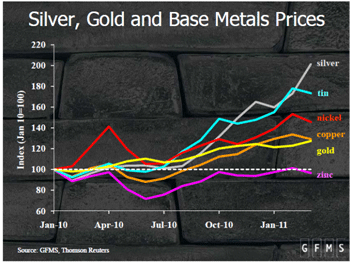
Certainly, silver does seem to have had a breathless run even compared to other metals:


Here are the key factors that could drive silver prices this year:

1. Fate of the U.S. economy. If the U.S. economy continues to falter and Federal Reserve returns with a third round of quantitative easing, U.S. dollar will fall further, leading to more investment plowing into gold and, as a spillover, into silver.

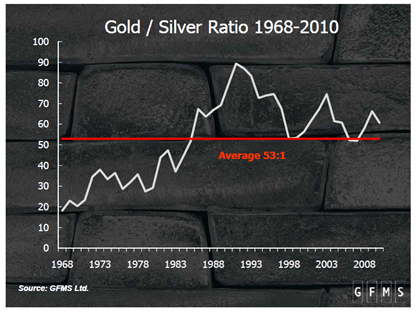
2. The gold:silver ratio has fallen sharply to 37:1 just recently, compared with an average of 62:1 in 2010. The gold/silver ratio is an important barometer for many commodity investors. If the ratio narrows, silver prices are seen to be doing better than gold prices.

When gold prices hit $850 in 1980 - the last time the price of silver was at this year's level - , the gold/silver ratio narrowed down to 17. The same ratio at these ratios, means silver could hit $80-$100, according to a range of analysts.


3. Like gold, silver is a hedge against inflation. Certainly the European Central Bank is worried and has recently raised interest rates to rein in inflation under its target of 2%. Inflation is already as issue in emerging markets and any sign of more easy money, especially from the U.S. Fed, will depreciate dollar strength. That, in turn, will raise oil and food prices, thus improving the case for commodity buying.

4. Silver is now the poor man's gold, as the high price of the yellow metal has made it difficult for many investors to get in.

5. But silver is also more prone to price volatility than gold. "Silver's traditional high price volatility and trading range are factors to consider: Already year-to-date $13 trading range ($26.68-$39.63) and average Q1 2011 price volatility 39.6% (gold 12.9%)," says GFMS.

"Investment will remain the main driver of the price. Silver's greater volatility in a smaller and less liquid market than gold is attractive to certain investors, with many now eyeing the all-time-high of $50/oz."

6. Suki Cooper, analyst with Barclays Capital, says silver prices could "see a sharper drop" than gold in the event of a precious metals sell-off, as a result of silver's "heavy bias towards retail demand... I think the real concern is if we see a slowdown in coin sales, or a slowdown in ETFs, the fundamental support for prices is much lower than where we are at the moment. I think we could see a much sharper correction in silver if investor interest starts to slow down across gold and silver."

"We think the industrial demand growth looks good, but not strong enough to drive prices where they are at the moment," she said. "We still have a market in a hefty surplus. So we think that support from the fundamentals is going to be much lower for silver in comparison to gold because in gold we've seen good physical demand materializing every time we've seen the price dip, providing a cushion for prices."

7. Demand for silver remains strong. GFMS says industrial demand in 2010 rose 20.7%, "a fraction shy of the pre-crisis record in 2008."

"Main drivers of the strong rise were continued robust emerging market economies growth, industrialized world's recovery from recession and pipeline restocking."

A significant boost in retail silver investment demand paved the way for higher investment in both physical bullion bars and in coins and medals in 2010. Physical bullion bars accounted for 55.6 Moz of the world investment total last year, says GFMS. "Increasing a hefty 47 percent last year to 178.0 Moz, implied net silver investment recorded its all-time high. Much of the increase was due to ETFs, the over-the-counter market, and investment in physical bars."

8. World silver production rose by 2%, or 17.6 Moz last year, to a new record high of 735.9 Moz. Adding to supply are governments who have also been selling silver with Russia leading the way. Government sales estimated at 44.8 Moz in 2010, up by a massive 188% on the previous year's level.

However, the new trend could well be central banks buying gold, which could lead to another bout of silver buying as well.

9. However, many investment banks seem unimpressed by silver's rally. Goldman Sachs price for silver in the next 12 months is $28.2, almost half of its current price. Bank of America Merrill Lynch's silver price forecast for 2011 is $29.5.

UBS analyst Mark Bulsing says: "While further advances in the short run cannot be ruled out, we do not expect current levels to be sustained," adding that he saw prices returning to around $34 this year, even though there may be a spike to US$55."

© alifarabia.com 2011 Original document

GOLD & SILVER PRICE MOVEMENT MAY 2011


Source : kitco.com

From the two charts above we can see that the prices are at a lower price from the peak. They have dropped last week and it will pick up soon. Those who have been waiting for the high prices of gold & silver to reduce to buy, this will be a good time to buy.


GOLD PRICES

At the point of writing, the gold price is at USD 1522.80/oz. For PG gold prices the price are as follows :


PG has introduced 10g gold bar last week, available for purchase. See the price movement every 20 minutes at the left hand side of this blog.
Do note that the peak of gold price is at USD1565.70/oz on 29th April, 2011


SILVER PRICES

Also, at the point of writing, the silver price is at USD 38.50/oz. Ratio of 39.55:1 to gold. For PG silver bars, the prices are as follows :-


The silver price peaks at around USD48.70/oz. The price now is 20% cheaper than the peak price. Why wait to buy? The silver price may not be any cheaper than today's price.


WHY YOU WANT TO BUY SILVER INSTEAD OF GOLD?
  1. higher rate of return
  2. easier to keep due to non-recognition of the silver bar
  3. good for long term investment
  4. usage of silver is higher
  5. high ratio between gold & silver


WHY YOU WANT TO BUY GOLD INSTEAD OF SILVER?

  1. easier to keep due to smaller in size
  2. easier to get cash
  3. lower spread

EQUAL BENEFITS OF BUYING BOTH GOLD AND SILVER BARS
  1. easy to buy
  2. easy to sell
  3. higher rate of return compared to any other investment
  4. minimum maintenance cost
  5. you own them

Do not hesitate to buy gold bars & silver bars. The bars comes with Authentification & Certificate from Independent Assayer. BUY ONE NOW.


Thursday, March 10, 2011

DISCUSSING GOLD PRICE MOVEMENT


The above is the chart from kitco.com on average live prices for 6 months. If we have a crystal ball, of course, the ideal time to buy gold is in the ‘ovalled’ area. I cannot say circled as the shape is oval ;-).

Why I choose this past 6 month’s period?

Because, I started enrolling to become a dealer the last 6 months (in Sept 2010) and I have suggested to you, as my readers in http://www.dinatalib.blogspot.com/ and my friends in Facebook, to start picking up (buy) some physical gold (gold bars / dinars).

The chart will repeat itself. It may not be exactly the same but there will be some similarities; same scenarios. Price will drop, price will shoot up, price being stagnant, rallies being resistence and support level etc. The history will repeat itself. What should you do? Educate yourself. Read a lot and ask questions.

Say that you bought gold at A. You have no slightest idea that the gold price will come down from that spot. At A, the price was USD1412.50/oz. Do not be despair if comes down, you should buy more if price is trending downwards. Any purchase when the price drops will reduce your average cost of investment. The price was later dropped to point B at USD1324/oz. It was a 6% drop. But we did not know about it then, did we? When the price was at B, we might think that the price will go down further. We wait some more, hoping to get a better price. If you did not buy the gold here, you lose good opportunity to get good price for your gold. However, the price did not go down further but it bounced back until now at point C (current situation). You really cannot time the price. Buy when you have extra capacity to do so.

Now, we are at C. Whe shall the price go from here? Will you buy now or wait for the gold price to come down? What will you do?

One possibility is that position C now will be replicated as D, ie gold price moves UP. I would just buy now if I were you. This is especially if you are just starting to invest in physical gold and besides, the physical gold investment is actually for medium to long term investment.

Buy Now

Another possibility is that position C will be replicated as position A, ie gold price drops. Nobody knows. Do you know what will happen?

With the political unstability in the Middle East and its chain reactions, as well as the continuity of the financial crisis in the West, there is a high chance that the gold price goes up rather than coming down. There might be some corrections to the prices on its way to find new heights. Why not buy now and see if the gold price really drops? If the gold price drops (even just for correction), buy again. Always set aside some budget for gold investment. There might be some good and cheap offers by many dealers as well along the way.


Kijang Emas Prices

Below is the Chart on Kijang Emas prices for 1oz during the same time period. Kijang Emas is the gold coin produced by Bank Negara Malaysia, sold by Malayan Banking Berhad. The selling price of 1oz Kijang Emas is captures as follows :-


Note that the lowest price within the last 6 months is just below RM4100/oz. We might not see the Kijang Emas 1oz sold at that same price again. The Kijang Emas price is strongly supported at RM4300/oz. At the time of writing, the Kijang Emas is sold at RM4555/oz.

Buy Now


Public Gold Gold Bar

Public Gold Gold Bars are sold in 20g, 50g, 100g, 250g as well as 50g Gold Coin. The live prices can be seen in the right hand side of this blog. The prices will be changed every 20 mins to reflect the movement of the gold price globally. It will be stagnant during the weekend starting from the time the US market closes on Friday.

Besides gold bar, Public Gold also sells 1 Dinar, 5 Dinar and 10 Dinar as well as silver bars in 3 sizes ; 250g, 500g and 1kg.

Buy Now
Buy Silver Now

I can give you so many reasons why you should not wait for the price to come down eg the price is in correlation with other commodities prices like oil, the increase of import of gold into China, the printing of more money in US, but it is YOU who have to take action.

Hedge your inflation NOW! Buy Gold or Silver.