Sunday, September 2, 2012

GOLD PRICE EARLY MORNING


Facts speaks louder than words.
Happy investing to all.

 See INDEX to start investing.


Tuesday, July 31, 2012

77 SYARIKAT PELABURAN TIDAK SAH

Kredit gambar : https://www.facebook.com/tokeyemas999

Source : Utusan Malaysia  01/08/2012
http://www.utusan.com.my/utusan/Ekonomi/20120801/ek_02/77-syarikat-pelaburan-tidak-sah

Oleh NORLAILI ABDUL RAHMAN
ekonomi@utusan.com.my

SYARIKAT-syarikat pelaburan emas dan barangan logam bernilai kini melakukan pelbagai taktik bertujuan menarik pelaburan daripada orang ramai dengan menjanjikan pulangan lumayan. - GAMBAR HIASAN
KUALA LUMPUR 31 Julai - Para pelabur di negara ini perlu berhati-hati membuat pelaburan kewangan agar tidak terjebak melabur ke dalam syarikat-syarikat pelaburan yang tidak mendapat kelulusan daripada Bank Negara Malaysia (BNM), termasuk membabitkan skim-skim kewangan yang melibatkan pelaburan emas dan logam berharga lain.

Menurut BNM, sejumlah 77 syarikat atau individu telah disenaraikan sebagai entiti yang tidak mendapat kelulusan dan tidak sah menjalankan aktiviti pelaburan mengikut peraturan kewangan di negara ini.

Antara jenis-jenis aktiviti yang dijalankan oleh syarikat atau individu tersebut kebanyakannya berkisar kepada pelaburan emas, perniagaan mata wang asing atau menjalankan pelaburan tidak berlesen.


Senarai lengkap 77 syarikat berkenaan adalah sepert di dalam link ini
http://www.bnm.gov.my/documents/2012/Financial_Consumer_Alert_listEN.pdf

Friday, June 22, 2012

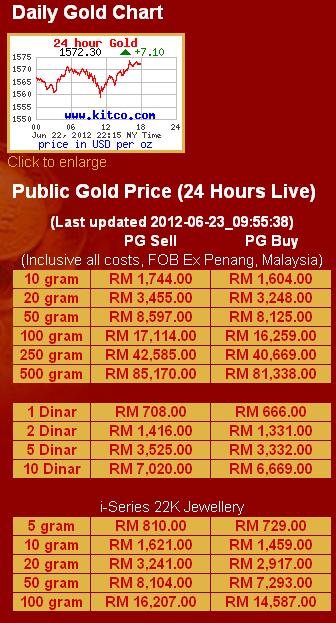
GOLD & SILVER PRICES OVER THE WEEKEND

The gold prices look very favourable this weekend.If you have been eyeing to buy, this is the time to buy.


What has happened for the last 60 days?


There is the scenario.
What do you think? I would say that it is a good time to buy.

Gold Becomes a Tier 1 Asset Class for Banks
 Despite what the Main Stream Media (MSM) or "Financial Pundits" tell you, the gold bull market is far from over. In fact, it is just starting, in our opinion. While the misdirected financial world tell you that gold is in a bubble and it has burst, the central bankers and government organizations all know it is far from over. In fact, gold is moving towards the banking system and not away from it. We all know that many central banks are now net buyers of gold and their holdings are increasing as their need to diversify away from risky assets and foreign bonds only grows.
Central banks around the world are continuing to stock up on gold. We can now add Kazakhstan's central bank to the grow list of bankers wanting to hold gold as a part of their currency reserve. The Kazakh central bank intends to have 20% of reserves in gold, this is up from the current 14-15% currently held. They plan to purchase 20 tonnes of gold this year, mostly from local producers. They also mentioned a few weeks ago that they would cut their Euro holding to 25 % from 30%. We can also add Kazakhstan to the growing number of central bankers which are building up gold holdings including China, Russia, Mexico, Colombia and South Korea.

The price of gold is now hitting all time highs in India, one of the biggest buyers of gold around the world. Prices have reached an all-time high of $544.74 US (Rs 30420) per 10 grams. With a slowing economy and low demand for the Indian rupee, it has been losing value lately and still remains weak. However, gold demand is still robust even at these elevated prices as investors in India still consider gold a safe haven as it counters the effects of inflation and exchange rate fluctuations.

Over the past five years, gold has provided Indian investors with a 27.19% annualized return versus a pathetic 2.67% in the equity market. This trend and move to gold has only grown in the last year. Gold assets under management by funds have increased almost 100% $1.83 billion by April 2012, last year the value was $981 million. In 2011, the gold ETFs in India saw a net inflow of $725 million. For thousands of years the Indian culture has had an affinity for gold, and that will never change, and neither will their demand for physical at elevated prices. Why? Indians understand that gold is money and a true form of saving. It's the only way to protect assets and wealth from government theft, something the West is still learning.

Even the good ol' USSA is starting to recognize gold as a tier one asset class. The Federal Deposit Insurance Corporation (FDIC) just issued a notice regarding a new policy proposal on how banks should revise the measurement of risk-weighted assets by implementing changes made by the Basel Committee on Banking Supervision (BCBS) to international regulatory capital standards and by implementing aspects of the Dodd-Frank Act.

How about Silver Prices?


The silver prices are now below USD30/oz. That's very cheap...

Good video to watch : 

SILVER - I'M BUYING THE INVERSE HEAD & SHOULDERS - MIKE MALONEY


Wednesday, May 23, 2012

GOLD GLITTERS BUT WILL IT GLOW? BFM INTERVIEW WITH DATO' LOUIS NG

http://bfm.my/assets/files/RinggitAndSense/2012_05_24_RinggitAndSense_PublicGold.mp3

Let's hear this out.
Dato' Louis Ng's radio interview with BFM Radio - The Business Station.

2001, gold price starts to boom until 2011. Gold is the excellent asset class.
2011, slow growth but positive
2012, no gain yet.

Forecast for this year (2012) depends on Federal Reserve (Fedex). Are they going to pursue on QE3?

QE3 : Quantitative Easing 3. In layman term, QE is the printing of US Dollars.
Question is will it take place?
If Fedex is going to launch/ pursue on QE3, the commodity price especially gold will jump.

Gold is part of monetary system.

Dato' Louis expected the gold price to increase by 15% to USD1800/oz - USD1900/oz by end of the year 2012.


Gold appreciates against USD. RM has any impact? 

Pegging period, USD1 : RM3.70 happened 14 years ago. Our currency appreciates from RM3.10 to RM3.70, an increase of 18% - 20%. Gold price appreciated more than that, then. Thus, offset of loss of currency strengthen is minimum.


How long do you need to hold gold?


People always look for return on every investment. As per Dato' Louis, the thinking has to be changed that we buy gold to protect our purchasing power in the real wealth term. In the market, too many people has too much money.

1971, Richard Nixon decide to back USD with gold. There is no gold to back. At that time gold price is only USD35/oz. Now gold price is about USD1600/oz. Multiple to 40 times.

Comparing price of nasi lemak in 1970s and now. Nasi lemak is the same. Commodity is still the same.

Commodity does not increase in price but because of the depreciation of the currency.

Mankind increase more fiat money, not backed with gold/silver, the currency with depreciate more.

Gold is the ultimate money.


Tuesday, May 22, 2012

EXPERIENCING ARRAHNU

AR-RAHNU AGRO BANK   


I shall write today my experience going to ArRahnu Agro Bank, Klang.


What is ArRahnu?

An Islamic pawn broking scheme based on Syariah principles of Al-Qard, Al-Wadiah and Al-Ujrah which provides a source of immediate financing to assist individuals in overcoming cash-flow needs, offering investment opportunities as well preventing from illegal/unlicensed financing activities.


Agro Bank only accepts gold jewelleries to be ArRahn.

Nowadays to 'rahn' your gold jewelleries, you have to come early to the bank and get your number.  Once ArRahnu Agro Bank finishes their allocated numbers, the officers will not entertain anymore people that day. You have to come on other days.

Once your number is called upon, you will be served by a Bank Officer. You have to fill up three types of documents as to ensure that you are the owner of the jewelleries and other terms and conditions. Your jewelleries will be tested to ensure that they are genuine and pure.  They will also be weighed to determine the actual weight.

The bank publishes the daily prices for the gold.

Say I bring 100g jewellery gold 916. The published price at Arahnu is RM183.70. Thus the jewellery has ‘nilai marhum’  amounting to RM18,370.00.
Maximum loan that you can take out is 70%.  Thus for your 100g gold bar, you can get cash of RM12,859.00 (at 70%)
The safekeeping fee 'upah simpan' is RM0.75 for every RM100 gold jewellery kept. Thus one month, the safekeeping fee is RM18,370/RM100 x RM0.75 = RM137.80
Maximum period you can keep for the first time is 6 months. Thus the storage fee for the 6 months’ period is RM826.65.

Details of ArRahnu Facility AGRO Bank is in the link http://www.agrobank.com.my/ar-rahnu


SAFEKEEPING FEE

Enjoy low administration fee as follows:

Margin
Pinjaman
Upah Simpan bagi setiap RM100.00
Nilai Marhun/Bulan
50%
RM0.50
60%
RM0.60
70%
RM0.75


PAWN DURATION

6 + 3 + 2 months
The first duration is for 6 months, can be extended for another 3 months and lastly for another 2 months.


AR-RAHNU TIME ZONE SDN BHD (HABIB JEWELS)

I was in Time Zone last Saturday, for fact finding.

Ar-Rahnu Time Zone Sdn Bhd is located besides Habib Jewels outlet Ampang Point.

Here, we can place Public Gold gold bar and dinar. You have to produce a receipt.

Price for gold bar 999 last Saturday is RM149/g. If you bring in 50g gold bar, the value or 'nilai marhun' is 50g x RM149/g = RM7450. 75% of the value can be arRahn to you = RM5,587.00. 
The ArRahn amount of RM5,587 is paid in cash, on the spot.

The maximum Ar Rahnu amount is RM100,000. However, Ar-Rahnu Time Zone limit RM10,000 per transaction.
If you bring in 250g gold bar, the 'nilai marhun' is 250g x RM149/g = RM37,250. 75% is RM27,937. ArRahnu can only give you only RM10,000 though.


How to avoid the situation?

  1. Bring in gold bars/dinar/jewelleries worth RM10,000/0.75 = RM13,000, which is equivalent to 80g gold bar 999 (or 90g jewelleries/dinar 916) for each transaction. 
  2. Bring your purchase receipt as well
  3. Do not bring gold bar 999 of > 90g for each transaction 

SAFEKEEPING FEE
Ar-Rahnu Time Zone's Safekeeping fee is 1% per month.


If you purchased a lot of gold bar, this can be an alternative to you should you require cash.


Wednesday, May 16, 2012

SILVER IN MEDICINE : SUPPORT FOR THE MARKET?

Tuesday May 15, 2012, 4:15am PDT
By  - Exclusive to Silver Investing News


Why silverware? Why didn’t people choose to eat and drink from palladium, ivory, or other materials? Of course many people did. Throughout history people have used gold, clay, wood, and a wide range of other items at mealtime. For many of those who chose silver, however, it was more than just a fad or a symbol of financial standing. Ancient civilizations reportedly used silver because they recognized a connection between the metal and their health. Today, people are also finding silver to be increasingly useful in health-related applications. But will these uses have a material effect on the silver market?

For thousands of years, individuals have used silver at the table, on the battlefield, and in healthcare. The metal has been relied upon to prevent and treat infections, to treat wounds, to prevent food spoilage, and to prevent water contamination. Since long ago, the metal has been credited as having antimicrobial, antibacterial, and antiseptic properties.


Medical uses of silver and preventative applications
Many readers have probably received a silver treatment at least once, as silver nitrate is commonly placed in the eyes of newborns to prevent infections that could cause blindness. Silver has also been widely used in dentistry to fabricate fillings.
Today, the uses of silver for its healing and preventative properties are growing.
For example, it was only in 2007 that the US Food and Drug Administration approved the marketing of silver-coated breathing tubes. Prior to this approval, according to the Centers for Disease Control and Prevention, every year, 15 percent of patients on ventilators contracted ventilator-associated pneumonia. For tens of thousands of people these infections proved fatal. Including silver in the fabrication of these endotracheal breathing tubes reduces this risk and has likely saved many lives.
Silver is also used in much the same way for catheters and other medical implantation devices. The metal is used to coat surgical instruments and emergency ward equipment to prevent and reduce the transmission of infections.
Wound creams, gels, and powders are made with silver, and the metal is fabricated into wound dressings because it is considered toxic to germs and can prevent the invasion and livelihood of bacteria and yeast. Silver has also been found to reduce the adhesion of dressings to wounds and thus improves the comfort of burn victims.
A recent edition of Silver News spotlights the Trinity Bed Protection System. The covering system is supposed to provide an effective and impermeable barrier between patients and the surfaces they lie on, such as mattresses and stretchers. A notable benefit of this bedding is that it is supposed to retain its antimicrobial properties even after repeated washings.
Karuma, which makes a tablet for children called the PlayBase Plus, is said to be embedding silver into the device’s touchscreens. This Silver Seal technology is used to help reduce the bacteria on the screen’s surface, thus providing protection for little ones.
Many people also believe that consuming dietary supplements containing silver can effectively treat and prevent certain conditions, including infections and viruses. Though these supplements may be available, the medical community has not been eager to rally around this type of treatment.
A few years ago, the FDA said silver has no known physiological functions or benefits when taken orally. The agency further warned that consuming silver could have adverse effects. These include argyria, which is the permanent and irreversible discoloration of the skin. Consuming the metal is said to have the potential to increase the body’s production of melanin, causing the skin to get darker when exposed to sunlight. The FDA also said silver can interfere with the body’s absorption of drugs such as quinolone antibiotics and tetracycline antibiotics.


Medical-related silver demand and the silver market
Anyone familiar with the silver market knows that industrial demand can be economically sensitive. During times of financial turmoil and uncertainty, fewer goods may be purchased and therefore less silver is required to make the products that contain it. But what about the health-related demand for silver? Do these applications provide a strong, stable base of support for the metal?
Many of the medicinal uses of silver are fairly new, and a large number are considered novelty items. Most silver-bearing health-related items are not new products. Rather, adding silver is considered to make an existing product better.
Given that the metal itself is a key selling point, its use provides a competitive advantage rather than a necessary cost, says a Silver Institute report.
The report also says that despite the initial cost of silver-bearing products, the longer-term benefits of reduced spending on aftercare may justify the economic cost of using these materials.
Perhaps only time will tell whether consumers at the pharmacy will pay more for bandages or first-aid creams containing silver than for those without it, or whether healthcare providers will spend more on silver-containing medical supplies to lower the risk of infection. But, the newness of silver in medical applications combined with higher costs suggests that demand for many of these products could be affected by economic factors.
Even if this scenario doesn’t play out, medical silver demand does not currently represent a large portion of overall fabrication demand. The quantities used in most applications are very small.
In 2010, total demand for all such applications was estimated to be less than 0.5 million ounces (Moz). While medical silver is considered a likely growth area, the associated demand is not expected to grow on an explosive scale. The Silver Institute report predicts that medical-related silver demand could approach 3 Moz by 2015.

SILVER - I'M BUYING THE INVERSE HEAD & SHOULDERS - MIKE MALONEY

BEAR MARKET OR BULL OPPORTUNITY?

Bears have had a number of reasons to stand tall lately since many recent developments that should have been bullish for gold haven’t been. But, even as prices have continued to fall, there are those who suggest that while bears may believe they are taking control, smart investors should be taking advantage of the opportunities.


Given the heightened levels of uncertainty and threat of turmoil in the Eurozone, gold should be raking in bundles of safe haven cash, but that isn’t happening. Instead, safety seekers are flocking to the dollar even as the US fails to harness its spending and its economic data loses some of the shine that was seen in the first quarter.
Followers of the market are well aware that gold had become addicted to loose monetary policy. The dependence has become so extreme that drastic price fluctuations can result from the mere suggestion of action or disappointment at the lack of such suggestions.
But this weekend, following weaker-than-expected data in April, which the markets interpreted as further proof of a slowdown, China slashed its reserve rate ratio. In doing so, banks, which now need to hold less cash, have more freedom to douse it on the public; however, the gold market has not taken notice.
“Welcome to the ‘new’ normal…where the perception that China is experiencing a worrisome deceleration supersedes the possible benefits of an accomodative stance by the government,”wrote Jon Nadler, Kitco Senior Metals Analyst.
India, which is a key market for gold, is displaying bearish attitudes through its lack of demand for the metal. The marriage and festive season has passed, international markets are sending negative cues about gold, and compounding these problems is the fact that even with falling prices the metal is still relatively expensive when purchased with volatile rupees. At R28,540 per 10 grams, an ounce of gold on Tuesday would cost over $1,650, about $100 more than in New York.
As if that isn’t enough ammunition for the bears, they can also celebrate the the gut-wrenching drop in gold prices.
Scotiabank said that while on the downside, it will become increasingly bullish as each support level is breached. Those levels, said the bank in its May metals report, are at $1,630, $1,623, $1,614, and $1,612. Gold has crashed through all of those levels, giving up all of its gains for the year. Tuesday, the metal hit the lowest levels seen since December 29.
Gold the commodity
Gold is now trading as a commodity. In this environment, bullish sentiment is drying up and fund managers have been exiting the market for weeks. Last month, gold Eagle sales saw a sharp decline. And last week Barclays Capital cut its forecast for gold by eight percent to $1,716, citing recent price declines and the slowdown in demand from India and China.
Though bearish tones may be growing louder, not everyone is convinced that gold is set to crash and burn. Nor is everyone ready to cash out and move to the sidelines.
Central banks are expected to stay in the market. Last year they purchased 440 tons of gold. Scotiabank is expecting this trend to continue as governments and sovereign wealth funds look to diversify away from fiat money.
“This should help to underpin confidence in bullion and in turn keep investor interest active, especially into price dips,” the bank said.
If central bankers’ attitudes are similar to those held last year, they should find the current price weakness very encouraging; in 2011 price declines often served as buying opportunities.
ETF investors, whether they are aware of it or not, are considered sticky money. In April, there was a trickle of outflows from these holdings. However, for the most part, ETF investors have lived up their moniker despite the downtrend of gold prices.
While it is certainly not an event worthy of champagne, investors added 2 tons to ETFs last week, which made them net buyers for the first time in a month. This occurrence came in the midst of a risk-off environment that by comparison saw silver ETF investors drop about 76 tons.
There is still a notable amount of optimism towards gold, though it may not get a lot of airtime at the moment.
Legendary investor Jim Rogers recently said that he is still bullish on gold, and that the the pullback in prices creates a value buying opportunity. A number of professional traders continue to hold their ground and see long-run opportunity in the market.
Even though Scotiabank noted that a fall below the aforementioned technical levels is bearish, it also added that moves below $1,550 may well turn into spikes.
“We believe that getting bearish on gold at current levels (c.$1,560) would be wrong and too late,” says a market note from Standard Bank. “In fact, we believe that from a risk/return perspective, gold should be bought, not sold, on dips lower than this.”


ORIGINAL ARTICLE
INDEX